
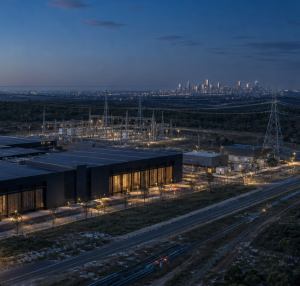
Australia’s AI strategy should be that of a middle power: build options, manage dependencies
Australia should welcome investment in artificial-intelligence infrastructure. But it should distinguish between financial exposure to global assets and reliable access to capabilities that may become economically and strategically important.
As the government begins to set out a more coherent approach to artificial intelligence and the infrastructure that supports it, Australia faces a choice familiar to middle powers: how to capture the benefits of global investment without losing sight of long-term capability and resilience.
Technology firms, investors and governments increasingly present data centres as productive infrastructure: critical to national competitiveness and a natural destination for long-term capital.
There is much to support that view. Artificial intelligence will require more computing capacity, electricity, networks, capital and technical skills. Australia has credible strengths: relative political stability, substantial renewable-energy potential, a sophisticated financial system, trusted institutions and a strategically useful position in the Indo-Pacific.
But the policy debate risks starting in the wrong place. The question is not simply how Australia can attract more data centres. It is whether the country will secure durable and diversified access to the computing capability it needs — or whether it will be principally a host for, customer of, and investor in assets controlled elsewhere.
That distinction matters because the United States treats advanced computing as both a commercial opportunity and a strategic asset. It is accelerating domestic data-centre development while promoting the export of a United States-led technology ecosystem, spanning hardware, cloud services, models, cyber security and applications. Access is offered, but within a framework shaped by United States policy, export controls and national-security priorities.
As Australia moves from broad intent towards more detailed policy design, the central task is not self-sufficiency. It is to build resilience and preserve choice: attracting global investment while retaining enough domestic capability and diversified access to avoid unmanaged dependence.
The middle-power problem
Australia will not reproduce the scale of the United States or China in advanced chip design, manufacturing, cloud infrastructure or frontier-model development. Nor should it try. A full domestic replica of those ecosystems would be costly, slow and unlikely to succeed.
Equally, passive reliance on a small number of foreign firms and jurisdictions is not a strategy.
Middle powers benefit from open markets, alliances and cross-border investment. They are also exposed when larger states use technology, trade, finance or energy as instruments of influence. The policy objective is therefore not independence from everyone. It is strategic optionality: enough domestic capability, diversified external access and institutional leverage that no single state or company can determine Australia’s choices.
Artificial intelligence sharpens this challenge because computing is becoming a general-purpose economic input. It will affect research, public administration, energy, health, education, industry, defence and financial services. Dependence on foreign capability may be efficient in normal conditions. It becomes more problematic where access is concentrated, difficult to substitute or subject to non-commercial constraints.
The United States has already shown that it regards leading computing capability as a national-security concern. Its policy combines restrictions on particular advanced technologies with efforts to promote a United States-led technology stack abroad.
For Australia, the appropriate response is neither withdrawal nor complacency. It is to remain an open and attractive market while preserving credible options where capability is essential, concentrated or difficult to replace.
Australia’s policy is moving
The Australian government has begun to recognise that artificial-intelligence infrastructure is more than a technology-sector growth story.
Its National Artificial Intelligence Plan identifies computing infrastructure, data centres and connectivity as national priorities. It seeks to capture economic opportunity, build domestic capability and attract global investment while strengthening safety, skills, research and national security.
The government’s expectations for data-centre and artificial-intelligence infrastructure developers are particularly significant. They signal that Australia welcomes large-scale investment—but expects projects to align with the national interest, support the energy transition, manage water responsibly, invest in Australian skills and jobs, and strengthen research, innovation and local capability.
This is a sensible starting point. It recognises that data centres are not simply commercial buildings, but substantial claims on electricity networks, generation, water, land, digital infrastructure and public-policy attention.
The more consequential work now lies in policy design: translating broad national-interest expectations into clear, investable and durable arrangements across energy, planning, security, skills and access to critical capability. The challenge will be to give investors sufficient certainty while ensuring that the public value created by this infrastructure is commensurate with the demands it places on the economy and energy system.
Maintain essential national capability
The practical implication is that Australia needs a clearer view of the computing capability it must be able to access, govern or substitute when external access is uncertain.
Not every workload needs to run locally. Most consumer applications and ordinary commercial functions will sensibly use global providers. Requiring universal localisation would be expensive, inefficient and counterproductive.
But some functions should not depend solely on discretionary foreign access. Australia should establish a sovereign capability floor for defence and national security, critical infrastructure, core government services, health, emergency response, sensitive research and selected strategic industries.
This does not require every server to be Australian-owned, or every model to be Australian-developed. It means Australia should be able to operate essential functions securely and reliably if overseas services are unavailable, commercially uneconomic or restricted.
The capability floor must encompass more than data-centre buildings. It requires secure cloud arrangements, trusted data governance, cyber resilience, technical skills, reliable electricity, communications networks and continuity plans that are regularly tested.
Sovereignty in this context is not a slogan. It is the ability to keep essential systems running when circumstances are adverse.
Foreign capital is not national capability
Australia should welcome well-structured foreign investment in data centres. Foreign companies bring capital, technology, technical expertise, operating experience, network investment and global customer demand. In many cases, partnership with global providers will be the fastest and most effective route to improving Australian access to advanced capability.
But foreign-owned infrastructure in Australia is not automatically Australian strategic capability.
Control matters, as do service terms, data location, operating decisions, technology supply, contractual continuity and the jurisdiction governing the provider. A facility may be physically located in Australia while the critical decisions about who can use it, on what terms and for which purposes are made elsewhere.
The same distinction applies to Australian capital invested offshore. A superannuation fund may earn an attractive return from a United States or European data-centre portfolio. But that investment does not automatically provide Australia with access to the capacity in a crisis, nor influence over the export controls, security restrictions or commercial decisions governing the asset.
The Anthropic episode in June is a useful illustration. The United States government directed Anthropic to restrict foreign nationals’ access to its most advanced models because of concerns that their cyber-security capabilities could be misused to identify software vulnerabilities. Anthropic suspended the models for all users while it developed additional safeguards; the controls were later lifted. Anthropic’s account of the episode sets out the directive, the temporary global suspension and the subsequent restoration of access.
The lesson is not that Australia should expect to be denied technology, nor that the episode predicts routine restrictions on allied access. It is that even globally marketed capability provided by private firms can be subject to national-security judgements in the provider’s home jurisdiction. In an era where advanced computing is increasingly dual-use, commercial access should not be assumed to be unconditional or permanent.
For Australia, that is an argument for diversification, resilient access arrangements and sensible domestic capability—not for disengagement from United States technology or foreign investment.
Do not socialise speculative electricity demand
The more immediate domestic policy issue is energy.
Data centres can support new renewable generation, storage and transmission. Properly located and structured, they may help finance new supply and provide flexible demand that supports grid stability.
They can also impose costs on consumers if developers secure oversized connections, projects fail to materialise, or network and generation investments are made against weak demand assumptions.
The International Energy Agency expects strong growth in data-centre electricity demand. It also warns that connection requests may exceed ultimate usage and that electricity-system investment can run ahead of realised demand.
Australia should maintain a clear principle: developers should bear the incremental costs created by their projects, while being rewarded where they genuinely add new supply, flexibility and system value.
That means credible capacity commitments, transparent demand forecasts, appropriate financial security, fair payment for grid upgrades, and realistic plans for additional generation and storage. Projects should also be assessed against water use, land impact, community acceptance and genuine local economic contribution.
This is not a case for punitive treatment of data centres. It is a case for making commercial incentives match system costs — and for avoiding a race between jurisdictions to offer concessions that leave households or existing businesses carrying the downside.
Investors should distinguish opportunity from concentration
Data centres may be attractive investments. Facilities with long-term, creditworthy contracts and reliable power can generate relatively predictable cash flows. They may suit long-horizon investors seeking exposure to digital infrastructure.
This applies across investor types:
- Retail investors may gain exposure through listed technology companies, data-centre operators, infrastructure funds or exchange-traded funds. They should recognise that many such investments are exposed to the same assumptions about sustained artificial-intelligence demand, chip supply, electricity availability and a small group of large customers.
- Superannuation funds may invest directly, through infrastructure funds, private credit, listed equities or co-investments. Australian funds already have meaningful exposure to domestic, regional and offshore digital infrastructure: Aware Super invested in an Asia-Pacific data-centre platform, while AustralianSuper has invested in a European, Middle Eastern and African data-centre business.
- Offshore investors should distinguish a sound financial allocation from a contribution to Australian strategic capability. An overseas data-centre investment may be commercially compelling without improving Australia’s assured access to computing.
“Infrastructure” should not become a substitute for analysis. Investors should test whether projected revenues are underpinned by binding, creditworthy contracts or by extrapolations of future demand; who carries the costs of power connections, delays and equipment replacement; how concentrated customers are; and how exposed a project is to refinancing or changing technology.
They should also ask whether returns depend on the continuing global availability of a small number of model, cloud and computing providers. This is not a prediction of disruption; it is standard due diligence in a market shaped by rapid technological change and evolving export-control policy.
The United States Securities and Exchange Commission’s recent staff interpretation on certain data-centre securitisations may make one route to debt funding simpler for qualifying transactions. It does not remove these underlying commercial, technological or geopolitical risks.
A middle-power agenda
Australia should pursue five connected objectives.
- Retain essential capability: Define, procure and test Australian-controlled computing capacity for core national-security, government and critical-infrastructure uses.
- Diversify dependencies: Avoid excessive concentration in one chip supplier, cloud provider, model developer, data-centre operator or foreign jurisdiction. Deepen partnerships with trusted allies while retaining credible alternatives.
- Treat energy as strategic: Support projects that genuinely add clean generation, storage and system value; avoid arrangements that socialise costs or privilege speculative demand.
- Convert investment into capability: Link public support, where justified, to skills, research partnerships, local technical employment, secure operations, supplier development and credible continuity arrangements.
- Use regional partnerships: Work with Japan, Korea, Singapore, India and European partners on trusted infrastructure, interoperable standards, cyber resilience, supply chains and reliable access to critical technologies.
This is not an argument for government direction of every technological choice. It is an argument for government to understand the national-interest implications when large, long-lived and strategically relevant assets are being built.
The policy test
Every major data-centre proposal, public incentive and cross-border investment should face a basic question:
Does this investment improve Australia’s productive capability, secure access to computing and energy-system resilience — or does it create costs and dependencies that Australia has not adequately priced, governed or diversified?
Australia should pursue artificial-intelligence investment. But it should distinguish financial returns from strategic access, growth from resilience, and openness from unmanaged dependence.
The countries that fare best will not necessarily be those that build the most data centres. They will be those that use global capital and technology well, retain capability where it matters, and preserve credible alternatives before they are needed.

